William Gibson’s Unevenly Distributed Future
The image is a complex infographic titled "William Gibson’s Unevenly Distributed Future: The Geography of AI Adoption (2026)." It visualizes the hierarchy and temporal lag of artificial intelligence expertise across different sectors of society.
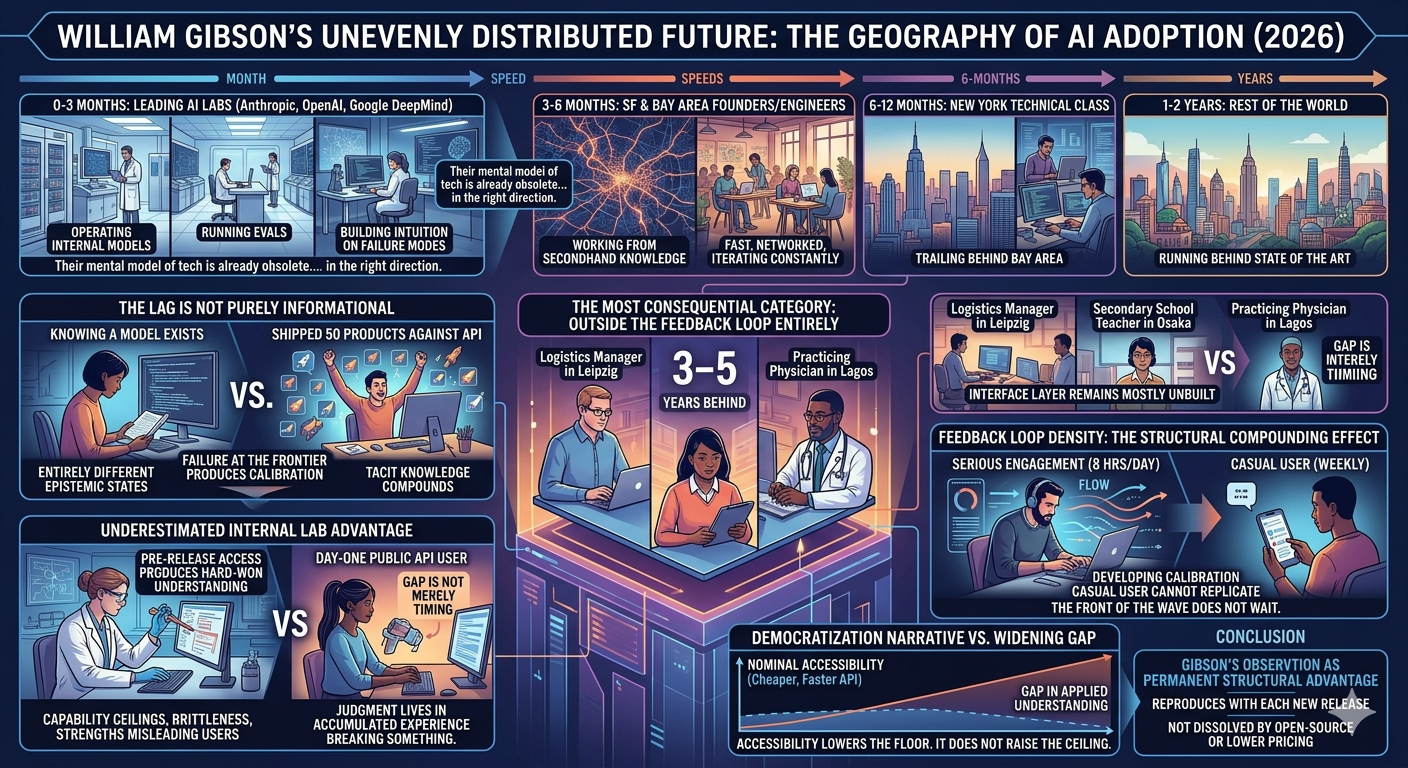
The infographic is structured into several key sections that detail why the "future" is not hitting everyone at the same time:
The Hierarchy of Adoption (Top Row)
The top section establishes a timeline of "readiness" or access to state-of-the-art AI:
- 0–3 Months (Leading AI Labs): Researchers at organizations like Anthropic, OpenAI, and Google DeepMind are at the frontier, operating internal models and building intuition on failure modes before the public even knows they exist.
- 3–6 Months (SF & Bay Area): Founders and engineers in Silicon Valley iterate quickly using secondhand knowledge from the labs.
- 6–12 Months (New York Technical Class): This group trails behind the West Coast hub.
- 1–2 Years (Rest of the World): Most global regions are running significantly behind the current state-of-the-art.
The Nature of the Lag
The middle and bottom-left sections argue that this gap is not just about having the software, but about "epistemic states"—the difference between knowing a tool exists and having "shipped 50 products" against it.
- Internal Lab Advantage: The graphic highlights that researchers stress-testing models gain "hard-won understanding" of capability ceilings and "brittleness" that cannot be learned from a manual or API documentation.
- Tacit Knowledge: True calibration comes from "breaking something" repeatedly at the frontier, a form of compounding knowledge that casual users cannot replicate.
The Widening Gap
The center and right-hand panels focus on the social and structural consequences of this distribution:
- The Outliers: It highlights professionals—like a logistics manager in Leipzig or a physician in Lagos—who may be 3 to 5 years behind because the "interface layer" between AI capability and their specific workflows remains unbuilt.
- Feedback Loop Density: A "Serious User" (8 hours/day) develops a level of calibration and "flow" that a "Casual User" (weekly) cannot match, even if they use the same tools.
- The Democratization Paradox: A graph at the bottom suggests that while "Nominal Accessibility" (lower prices/faster APIs) lowers the floor for entry, it does not raise the ceiling. Consequently, the gap in applied understanding between the frontier and the median user is actually widening.
Conclusion
The infographic concludes that this distribution is a "permanent structural advantage" that reproduces itself with every new release, suggesting that simply making AI cheaper or open-source will not dissolve the hierarchy created by those who live "inside" the technology.